
Chino Hills Directory Collections
The first task is to widen the place name. Chino Hills incorporated on December 1, 1991, while older directory publishers grouped Chino with nearby communities. A good city directory search may need Chino, Ontario, Upland, Pomona-area, Carbon Canyon, Los Serranos, Sleepy Hollow, or San Bernardino County as a heading. The collection table separates verified anchors from items that still need a librarian or catalog check.
| Collection | Years | Where held | Access |
|---|---|---|---|
| Ontario, Upland, Chino, Claremont, La Verne, San Dimas regional volumes | 1931, 1934 verified | NARA directory list and holding institutions | Consult the listed or licensed collection |
| Chino directory editions | 1928, 1931, 1934, 1940 identified | Established genealogy catalogs and historic directory abstracts | Verify the exact edition and scan |
| Chino Sanborn Fire Insurance Map | February 1895 | Library of Congress | Four free digitized sheets; old Chino only |
| Great Register of Voters | 1866-1908 | San Bernardino County Historical Archives | In-house when the archive reopens |
| County probate proceedings | 1853-1926 | County Historical Archives and Arrowhead catalog | Archive route, with privacy limits |
| Federal census | Decennial through 1950 public | NARA, FamilySearch, and library databases | 72-year release rule |
The San Bernardino County Historical Archives source captured for this city directory provides the local archive route. It is especially important for probate, Great Registers, and early county vital history, although the building was closed during the 2026 inspection.
Archive staff direct researchers to ARC-DLRecArchive@arc.sbcounty.gov and 909-387-1001, so a catalog question can move forward even when an in-person visit is not possible.
Chino Hills Directory Geography
The city directory geography predates the city. Chino Hills was county territory before incorporation, and the hills, canyon, and southern communities appeared under broader place labels. That is why an exact-name search can look empty even when a regional volume contains the right family. Use the publisher’s coverage area, not today’s city boundary, as the first filter. Census QuickFacts supplies present-day city context, not a historic directory list.
Carbon Canyon and Sleepy Hollow can be meaningful historical search terms. Los Serranos, Butterfield Ranch, Fairfield Ranch, Vellano, and Village Oaks or Oak Ridge can help with modern geographic context. None is proof that a specific entry belongs to a present neighborhood. Match an address, occupation, spouse, or later record before merging two names.
Note: A Chino heading in an older city directory can be the correct path to a Chino Hills family, but it does not by itself identify the modern municipal boundary.
Verified Chino Directory Editions
Research identifies Chino editions from 1928, 1931, 1934, and 1940 through established genealogy catalogs and historic environmental directory abstracts. The source material does not establish that every edition is digitized or that every page covers today’s hills. Treat the year as an anchor for a catalog request, not a promise of an online scan.
The 1931 and 1934 regional volumes are especially useful because they group Ontario, Upland, Chino, Claremont, La Verne, San Dimas, Alta Loma, Cucamonga, and Etiwanda. A person can move between sections in the same volume. Read the title page and publisher geography before assuming the book is a city-only directory.
The National Archives list of 1930s city directories is the verified online anchor for the regional run. It helps identify a holding institution even when the page image is not public.
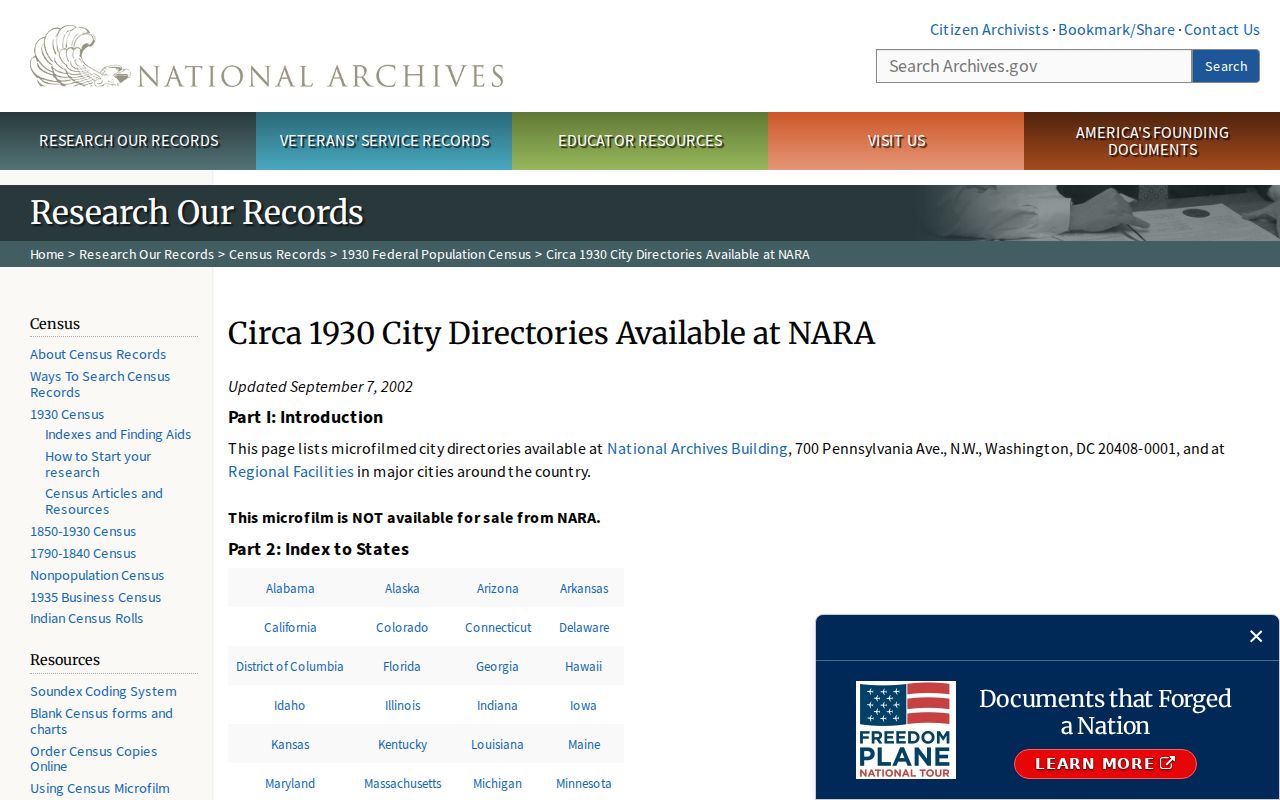
The NARA source confirms the regional publishing geography. It does not establish a complete Chino Hills household list, so a catalog record and the actual volume still matter.
Reading Chino Hills Directory Entries
A period city directory usually rewards slow reading. Start with the front-matter abbreviation key. Then compare the surname page with any street or criss-cross section. Exact local scans were not open in an official free viewer during research, so local abbreviations should not be invented from a generic volume. The entry fields below are a research inventory, not a fabricated Chino Hills person record.
- Name: surname followed by given name or initial.
- Family marker: spouse in parentheses or a widow notation where the publisher used one.
- Work: occupation and sometimes employer or business heading.
- Residence mark: “h” for householder or “r” for resides or rooms, if the volume defines those marks.
- Place: street address and, in some volumes, a telephone or business entry.
- Householder index
- A name section arranged by people, often with the address and occupation beside the entry.
- Criss-cross directory
- An address section arranged by street location, useful for seeing a named householder or nearby entries.
- Abbreviation key
- The publisher’s front-matter explanation of marks such as householder, roomer, widow, or occupation shorthand.
- Snapshot
- A dated record of what the publisher reported, not proof that every household member was present all year.
A directory name should be copied exactly, including initials, spacing, and any name-before-marriage note. Those small marks help separate people with the same surname.
Chino Hills Criss-Cross Pages
The criss-cross page changes the question from “who is this person?” to “who was listed at this address?” It is useful for a house-history project, but only if the regional volume includes the address and the publisher’s coverage. Search the street section, copy the exact number and spelling, then return to the name section to read the occupation or spouse clue.
Modern Chino Hills shelf coverage is uncertain because the official Thalman Branch page does not publish an itemized run of city directories, telephone books, reverse directories, obituary indexes, or newspaper microfilm. Ask the librarian to search Chino, Ontario-Upland-Chino, Pomona regional, yearbook, and local newspaper terms. Library catalog access and database licenses can change.
For current address-keyed work, use the Chino Hills street directory record chain. That page keeps the assessor, APN, deed, permit, and street-map method separate from the historic collection itself.
Tracing Chino Households Across Years
A household trail gains strength when directory years bracket a census rather than stand alone. Start with a known person and a likely place. Record the full entry, address, occupation, spouse mark, and publisher abbreviation. Then compare the nearest census and the next two or three directory editions. A disappearance can mean a move, death, a missed volume, an unlisted person, or a change in publisher coverage.
- Find the first likely name in a Chino or regional city directory and copy the full entry.
- Check a census around the same period for age, relationship, occupation, and household members.
- Follow the name through later directory years, noting every address or occupation change.
- Use a criss-cross section to compare nearby entries when the volume supplies one.
- Close a gap with an obituary, probate file, deed transfer, marriage or death record, or another dated source.
The public census run reaches through 1950 under the 72-year release rule. A directory year fills the space between census decades but does not replace the census or a civil certificate. For a modern identity question, the trail should move to a current custodian rather than stretch an old entry forward.
Thalman Library Directory Questions
The James S. Thalman Chino Hills Branch is a San Bernardino County Library branch at 14020 City Center Drive, with telephone 909-590-5380. Its official web presence lists catalog, databases, and librarian help, but not a confirmed item-by-item Chino Hills city directory shelf. A good request asks for the catalog terms, date range, publisher, local-history room access, microfilm or newspaper holdings, and current Ancestry Library Edition or HeritageQuest license.
Library staff can also help distinguish a city directory from a telephone book, yearbook, school directory, or obituary archive. A title that includes Chino may be more useful than a title that claims modern Chino Hills. Ask for the exact volume and page before relying on a catalog label.
The Library of Congress city-directory guide captured for this project provides a national access map and explains why library and genealogy collections often hold the scans.
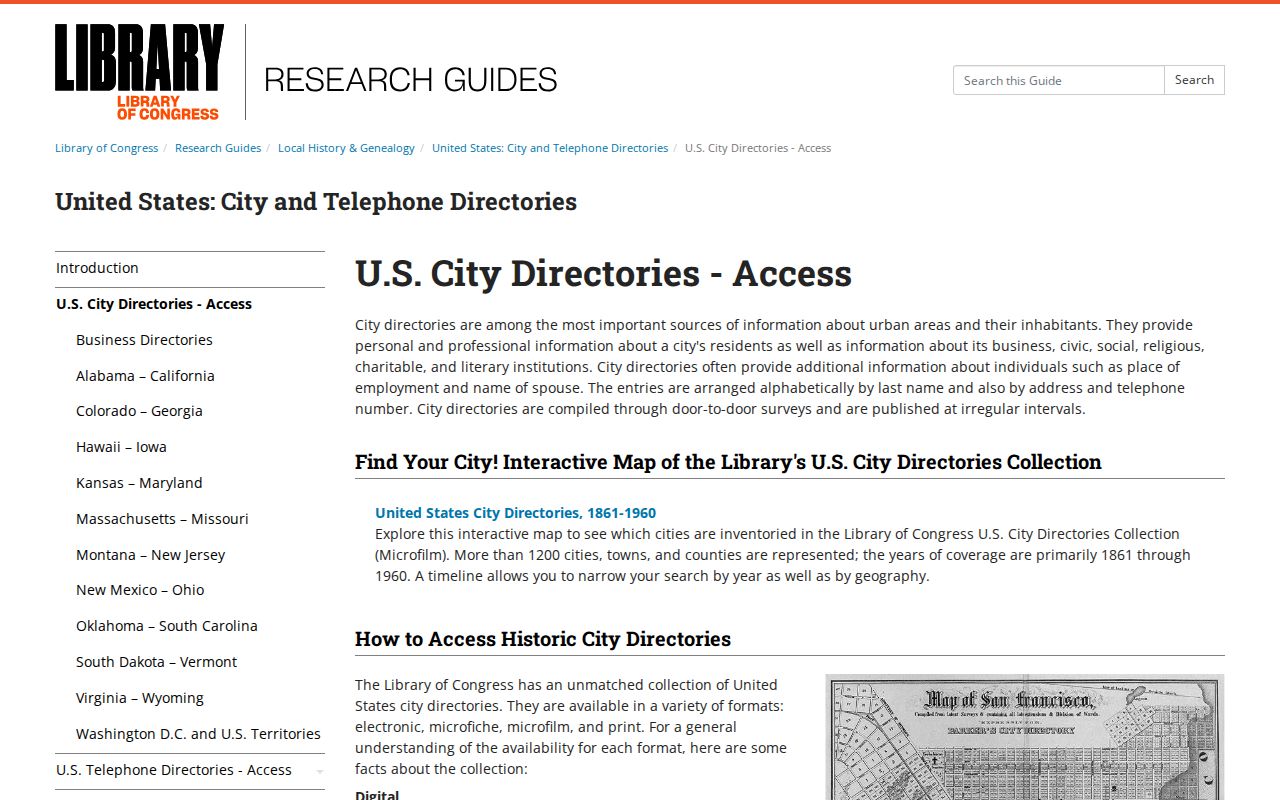
The guide is a route to collections, not a substitute for confirming the Chino or regional edition that contains a particular address.
Chino Hills Great Registers
Great Registers are older election records, not modern voter-browse tools. The County Historical Archives holds San Bernardino County registers from 1866 through 1908. Depending on the year, an entry may include occupation, age, height, physical description, and naturalization status. Names are alphabetical. The archive’s current closure makes email and phone contact important.
Great Registers pair well with probate, directories, and census material when a family-history question reaches before modern portals. They do not establish that a person lived at a current Chino Hills address, and they should not be read as a current resident roll. County vital indexes are confidential under Health and Safety Code section 102230, so the permitted certificate route still controls.
Chino Hills Business Affiliations
A city directory often records an occupation or business heading. A modern follow-up can use California Secretary of State bizfile to test whether the same name appears in an entity filing. Bizfile covers corporations, LLCs, limited partnerships, and nonprofits, with more than 17 million business documents. Basic search uses a name or file number, while advanced search can filter entity type, status, and initial filing date. The result may show an agent, street or mailing address, and free filing PDFs.
The filing adds an affiliation clue. It does not prove that the agent, officer, manager, or business contact lived at the filing address. General partnerships and LLP records fall outside normal online coverage, and a filing summary is not a certified statement of residence.
The California bizfile program source captured for this city directory shows the modern filing route that can supplement, but not replace, the historic shelf.
Use the entity number, filing date, and document PDF to distinguish an affiliation from a same-name coincidence.
Chino Hills 1895 Map Context
The Library of Congress holds a free, four-sheet Sanborn Fire Insurance Map of Chino from February 1895. It shows the built center of old Chino, not the later hills subdivisions incorporated as Chino Hills. That boundary is the key fact. A Sanborn sheet can explain an older family’s place and land-use setting, but it should never be presented as a house-level map of modern Chino Hills.
Map context helps when a directory says Chino and a present-day search expects Chino Hills. Compare the map’s town setting with the directory’s publisher geography, then use a deed, census, probate record, or family source to establish the person’s actual place. The old map is a story about records geography, not a current address source.
When Chino Entries Disappear
A name that vanishes between directory editions does not have one fixed meaning. The household may have moved. The person may have died. The publisher may have changed its coverage. A spouse may have become the listed householder. A rural route may have been renumbered or refiled under another community. Check the next two editions before treating the gap as an endpoint.
Probate petitions and notices can identify a decedent, petitioner, heirs, and property. Obituaries can supply relatives and service dates, but no complete official local obituary index was verified. Deed transfers can show ownership movement. A later license or business filing can show public affiliation. Each source should be dated and matched by geography before the names are joined.
Research lead. When a Chino Hills city directory trail breaks, widen the place heading first, then test the next directory, census, obituary, probate, and deed source in that order.